
Mason City Address History Sources
Mason City previous residents appear in sources created for different purposes. A deed index tracks recorded transfers. An assessor card supports valuation. A printed directory links a subscriber or business with an address during one edition. The census describes a household on an enumeration date. Start with the source closest to the period being studied, but use at least one other record to test the link.
| Record source | Time span or cutoff | Place to consult | Address-history value |
|---|---|---|---|
| General deed index | 1854-1908 historical series | State Historical Society and county routes | Grantor, grantee, and legal-description leads |
| Land and town-lot records | 1855-1903 and 1856-1902 | State Historical Society of Iowa | Land-book and Mason City lot history |
| Historic/current transfers | 1850-June 30, 2013; June 30, 2013-present | Auditor, Cott, and Tyler routes | Transfer-book and deed-chain leads |
| Local Polk directories | Surfaced runs from 1900 through 1960, with gaps | MCPL, NCIGS, and area collections | Dated name, address, and business clues |
| Telephone directory | May 1958-May 1961 | Library of Congress online | Subscriber, address, phone, and civic guide |
| Federal census | Through 1950 under the 72-year rule | National Archives | Household and relationship snapshot |
| Assessor sales | Pre-1995 sales absent online | Assessor portal and paper files | Owner and sale clues where available |
For a nineteenth-century lot, begin with historical county series. For a mid-century home, place printed directories beside the census. A recent trail usually starts with the assessor, tax portal, and recorder, then moves into paper files when online records stop.
Mason City Deeds Run Backward
The Cerro Gordo County Recorder keeps real-estate instruments and links Tyler Web and Iowa Land Records. Its index is a card-catalogue-like lead, not the recorded document itself. Capture the parcel number, legal description, and current owner from the assessment or tax display first. A legal description usually survives address changes better than a house number.
- Find the present parcel, situs address, legal description, and current assessment record.
- Search Iowa Land Records or Tyler for the latest deed by county, party, date, and document type.
- Open details or an image when access permits. Save recording and execution dates, instrument number, book and page, parties, and cross-references.
- Search the seller as an earlier grantee. Check mortgages, releases, easements, probate deeds, court orders, and plats when the sequence breaks.
- Move to the historical index books, Auditor Transfer Book, paper books, or state archives for older work.
Do not call the most recent visible deed a full title history. A transfer may result from an estate, sheriff sale, tax sale, or court order. Those records explain ownership but still do not prove which previous residents slept at the address.
- Grantor
- The party transferring a property interest.
- Grantee
- The party receiving that recorded interest.
- Chain of title
- The linked sequence of transfers for the same legal property.
- Legal description
- The lot, block, subdivision, or land wording that identifies property apart from its mail address.
Mason City Deed Search Screens
The Iowa Land Records simple search shows the statewide route used to narrow a Cerro Gordo deed inquiry by party, county, date, and record type.
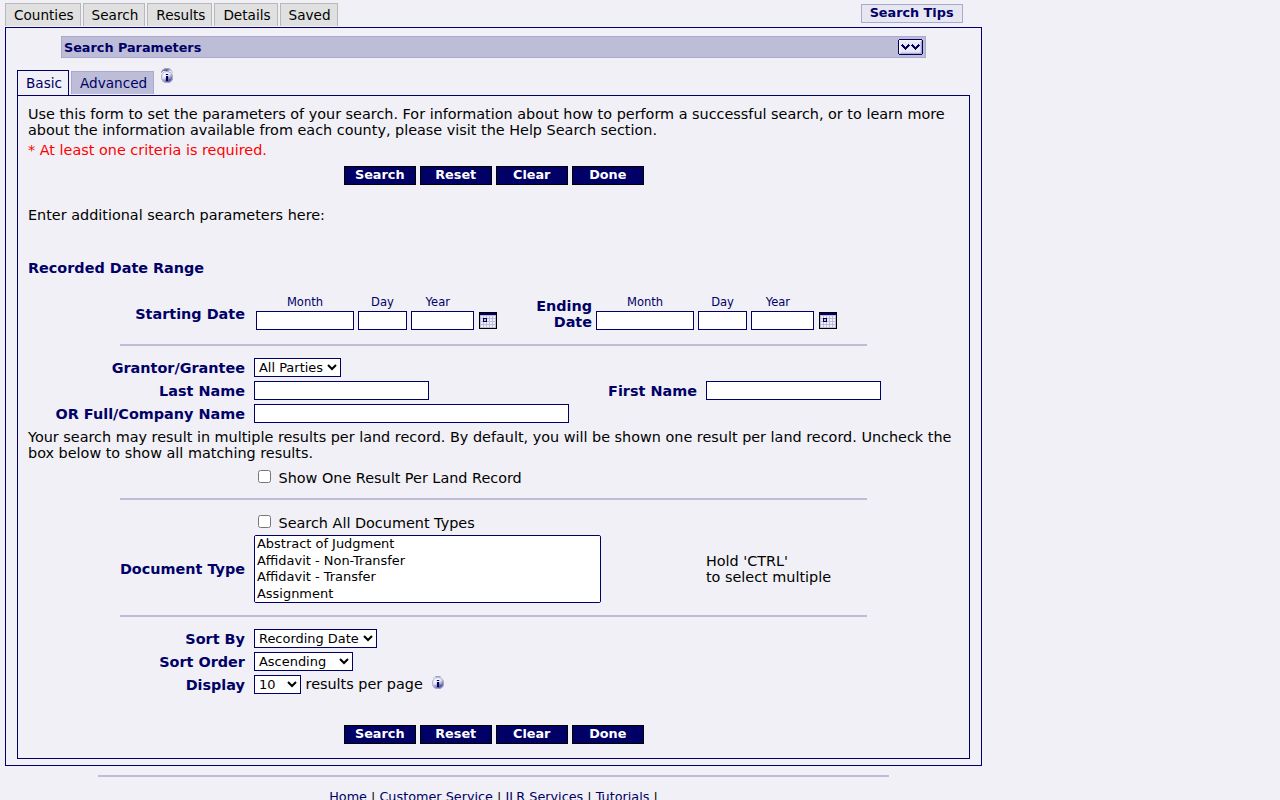
The screen is a starting point. Preserve the query and access date, then confirm each hit against the document image and matching legal description.
The State Historical Society Cerro Gordo inventory maps older deed, town-lot, probate, naturalization, vital, transfer, and tax-sale series in state custody.
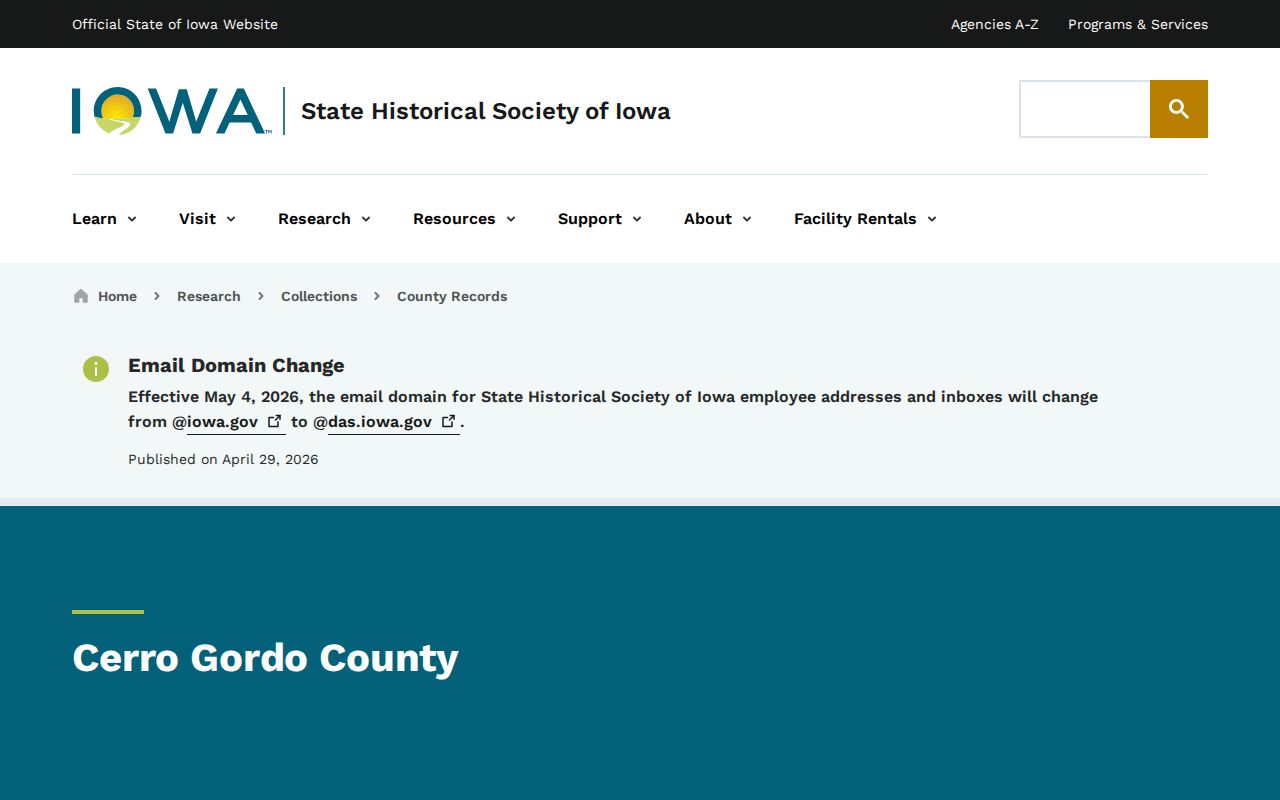
That finding aid identifies the right book before a visit or request. It keeps an online gap from being mistaken for a missing record.
Mason City Households Between Censuses
Owners are only part of house history. Mason City directories can place a subscriber, business, or named resident at an address during a dated edition. The public federal census can show a whole household, age, and relationships, but only at its enumeration date. Pair both sources to trace past residents between census years without treating silence as proof that nobody lived there.
- Search the nearest directory by surname and exact address. Check quadrant marks such as NW, NE, SW, and SE.
- Read the page image when OCR drops initials, punctuation, line breaks, or an old telephone exchange.
- Compare editions before and after the target date. Note first appearance, last appearance, and address or role changes.
- Open the matching census through the National Archives census route and verify names, relationships, street, and household context.
- Use deeds, probate, obituaries, cemetery files, or vital indexes only when they support the same person and place.
The 1890 census is largely lost after the 1921 Commerce Department fire. Bridge that interval with the 1880 and 1900 schedules, directories, deeds, probate, church or cemetery files, and newspapers. The collection itself is covered on the Mason City city directories page.
Mason City Directory Gaps Matter
Catalog work surfaced R.L. Polk runs for 1900-01, 1903-05, 1907-11, 1913-16, 1922, 1924-26, 1928-30, 1932, 1934-35, 1938-42, 1945, 1947, 1950, 1953, and 1955-60. Exact local shelf gaps need confirmation. No separately labeled Mason City reverse or criss-cross run was found online, so an alphabetical volume must not be described as an address index without checking its sections.
Ask Mason City Public Library Archives or North Central Iowa Genealogical Society for reverse directories, Polk sections, telephone books, plats, maps, and obituary files. MCPL takes archive questions by phone and appointment. NCIGS accepts research requests and maintains a nine-county library. Both routes matter when a volume is not digitized or OCR fails.
Note: A missing edition or name is an unresolved gap, not proof that a household left Mason City.
Mason City Old Address Cautions
No official Mason City street-renumbering or renaming chart was located. Do not borrow Clear Lake's documented 1949 conversion as a Mason City rule. Preserve the old address exactly, including quadrant, suffix, rural route, and historical exchange, while testing its modern form as a separate search.
Use the 1958 directory civic guide, Iowa DOT map, city and county GIS, plats, Recorder town-lot indexes, and deed descriptions together. If the match stays uncertain, request engineer street records, ordinance changes, annexation maps, and archive maps by decade. Report both forms and the gap instead of forcing an equivalence.
Mason City Records Beyond Portals
The assessor says sales before 1995 do not display in the computerized system. Ask the Mason City or county assessor for paper property and sales records. At the Recorder, request older index books and instrument copies by phone, email, mail, or in person. Auditor transfer records and plats provide another check. Clerk of Court probate files may explain an estate transfer.
Iowa Chapter 22 supplies a fallback for existing, nonconfidential records. A narrow request should identify the parcel or legal description, exact address, record family, and date range. Ask for electronic delivery, a cost estimate, and the legal basis for withheld fields. Examination is free, though reasonable actual retrieval, supervision, and copy costs may apply.
Mason City Residents After Departure
Probate, obituary, cemetery, naturalization, and vital indexes can resolve what happened after a name vanishes. Cerro Gordo holdings include a probate general index for 1885-1987, wills from 1857-1934, and several estate series. NCIGS holds obituary and necrology material, cemetery resources, directories, and local compilations. Its early obituary project used Globe Gazette floppy disks and moved online in summer 1993, a local preservation story whose exact coverage still needs staff confirmation.
Keep each endpoint tied to its role. An heir named in probate may not have lived at the property. A burial record does not prove a last address. A vital index may identify an event while restricting its certified copy. These records corroborate previous residents only when names, dates, relationships, and address evidence align.
Use Mason City History Lawfully
A sound result separates ownership, occupancy, mailing, business, and historical-directory roles. Cite the edition, image, book and page, instrument, map layer, query date, and unresolved conflict. Avoid publishing birth dates, personal contact details, confidential vital material, protected addresses, or facts unrelated to the house-history question.
Iowa Safe at Home provides substitute addresses and confidential voter participation for qualifying survivors. Pre-existing and real-estate records have stated limits, but no search should reverse-engineer a protected location. Keep living people out of a public narrative unless their names are essential and safely supported.
For a clear house-history file, save each dated source and state what it proves. Keep the current parcel card apart from the old directory image, and keep both apart from a deed or probate file. Note spelling variants, initials, spouse names, page numbers, legal descriptions, and the date each portal was checked. When two records conflict, report the conflict and ask the Recorder, Assessor, library archivist, or genealogical society for the underlying book. This method preserves uncertainty while building a useful trail of Mason City previous residents.
Cerro Gordo's archival series can settle a gap that modern portals leave open. The State Historical Society lists town-lot records from 1856 to 1902, a general deed index from 1854 to 1908, probate deeds from 1893 to 1919, and Auditor transfers from 1867 to 1914. Record the exact series, book, page, and archive reference when one supplies the missing link. Then compare its legal description with the Mason City parcel and directory evidence before assigning a past resident to the address.
Lawful use. Research previous residents for genealogy, estate work, or the history of a Mason City house. Never use an address trail to stalk, harass, threaten, or harm anyone.